Air-source or water/ground-source? A practical selection guide for industrial heat pump projects
Most heat pump tenders are lost at selection, not at price. Six checks we run with consultants and contractors before a model number is fixed.
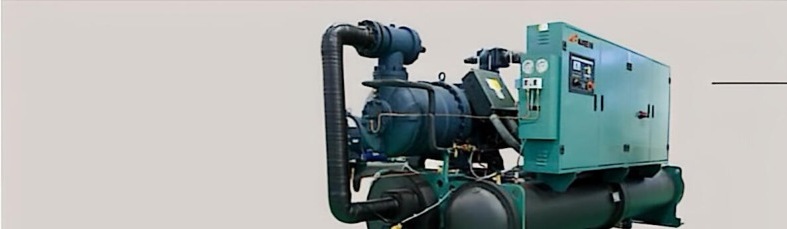
A heat pump's usable output depends on the lift between source temperature and supply temperature. Air-source units lose capacity as ambient falls — exactly when heating demand peaks. Water and ground sources hold a steadier temperature, so the same nominal kW delivers more usable heat in January. Ask for capacity at your design ambient, not at rated conditions.
1. Temperature lift, not just capacity
Read the capacity table at the design outdoor temperature and at the design leaving water temperature of your project. If the sheet only prints A7/W35 or A2/W35, ask for the interpolation at your real condition before the plant room is sized.
2. Source availability and water quality
Ground-source and water-source systems need a reliable source: boreholes, groundwater, a lake loop or a plant water circuit. Water quality decides heat exchanger material and cleaning interval. Open-loop groundwater needs filtration and a discharge plan; a closed bore field must be sized for the annual load, not the peak load.
3. Footprint, weight and rigging reality
Air-source equipment needs free air, service clearance and roof structure to carry it. Water-source and ground-source indoor units are compact but heavier per kW, and they need plant-room access — check door widths and lifting capacity before the drawing is approved. Our SGHP(A) range runs 260 to 2200 with unit weights from 1,500 kg upward; SGHP(M) reaches 15,100 kg at the top size. That is a rigging conversation, not a catalogue one.
4. Part-load behaviour and controls
Most operating hours are part-load hours. A single large compressor cycling on and off is efficient on paper and expensive in practice. Modular arrangements and staged compressors keep loading smooth: the SGHP(M) range uses two compressors from the 1200 size upward, and GSHP(HT) splits from 500 upward. Ask for the control sequence, the staging logic and whether the unit can talk to your BMS.
5. Noise, and where it lands
Air-source units put the noise outdoors, at the point where neighbours are. Water-source and ground-source units put it in the plant room, where it is easy to treat. For hospitals, hotels and residential blocks, that alone can decide the architecture.
6. Economics over the whole year
Compare annual energy, maintenance access, source-side pumping energy and expected service life — not first cost alone. A ground-source system usually costs more at the bore field and less at the plant; an air-source system is cheaper to install and more sensitive to weather.
The six checks side by side
| Criterion | Air-source | Water / ground-source |
|---|---|---|
| Capacity at design heating condition | Falls with ambient temperature | Stable, driven by source temperature |
| Installation cost | Lower, no bore field | Higher, bore field or water circuit |
| Footprint | Outdoor, area-hungry | Compact indoor plant room |
| Noise location | Outdoors, near neighbours | Indoors, easy to attenuate |
| Part-load flexibility | Depends on module count | Compressor staging, modular range |
| Maintenance exposure | Weather-exposed coils and fans | Water quality, exchanger cleaning |
How we support the decision
Every water/ground-source series on this site carries a model-level table — cooling and heating capacity, input power, load-side and source-side flow, refrigerant charge, pipe sizes, noise and weight — plus a downloadable datasheet in PDF. Send a load schedule or a BOM and we return a selection, a drawing and a test plan, not a brochure.